
Discover the benefits of nearshoring and if it can be applied to your business


What is nearshoring?
Nearshoring is the practice of moving work and jobs to a nearby country instead of a distant one. As a result, companies keep the cost savings of outsourcing while staying close to their teams. This model now shapes the future of nearshore outsourcing.
- You hire talent in a neighboring country rather than one far away.
- You gain shared time zones, similar culture, and easy travel.
- You still cut labor costs, much like offshoring.
Rather than hiring workers in faraway countries, nearshoring lets you outsource to neighbors. So this approach adds more flexibility and stability for both sides. Many firms use it when full offshoring or classic outsourcing does not fit their plans.
Companies often work with nearshoring companies when they want a middle path. This type of outsourcing overlaps with those models. Still, it brings clear perks that offshoring and onshoring cannot match. For a wider view, see our guide to outsourcing to Latin America.
Nearshoring vs. offshoring
In short, nearshore outsourcing means hiring for services in nearby nations. Offshoring, on the other hand, means hiring in distant nations. Both differ from onshore outsourcing, which hires from another firm inside your own country.
For example, companies in the United States may nearshore to Canada and Mexico. Full offshore work might go to India, the Philippines, Argentina, Brazil, or Eastern Europe. Some firms move operations to other continents to widen their talent pool. However, offshoring can create a cultural gap with the outsourced team. To weigh both, read more on the difference between offshoring and nearshoring.
Advantages of nearshore outsourcing
Nearshoring gives clients many benefits that only nearby partners can offer. In general, these perks match those of offshoring. For example, you get skilled labor, expert advice, and fast turnaround times.
Some other benefits of a nearshore partner are:
- Higher quality team
- Access to global supply
- Quality control
- Better software development
- Skilled workers
Keep in mind that these models aim to save money without hurting quality. So to get the full value of a proper nearshoring model, you can look to an expert like Sourcefit.
Access to a neighboring country’s talents
In the USA, companies often nearshore both salaried and hourly staff to nearby countries in South and Latin America. Countries like Mexico, Cuba, Colombia, and Peru are hotspots for American employers who want experts across many sectors.
European countries rarely leave the continent to outsource. Instead, western nations nearshore jobs to their eastern neighbors. There is no doubt that distance shapes how both sides grow. Because of this, closer nations share information faster, and nearby knowledge sources lift performance.
Lower labor costs
Nearshore work can be more cost-effective, based on the location and the task. Still, this is not always the case. Nearshore software development, for example, is a specialized skill. As a result, its labor costs may run higher. If you plan for such roles, review the benefits of nearshore software development first.
In Mexico, a day of work often costs far less than in the US. This minimum wage may look low for skilled pros. However, Mexico is a developing country, so living costs are lower too.
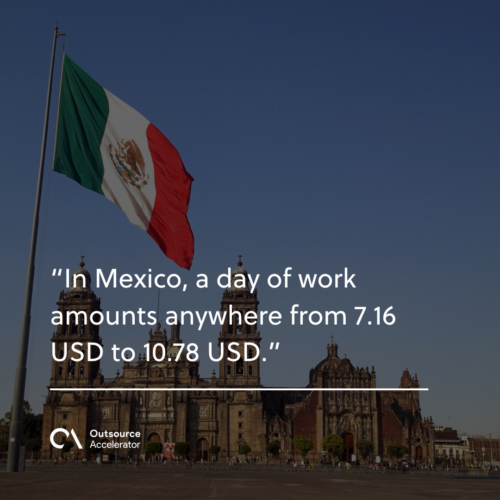
For many US and Canadian firms, nearshoring to Mexico beats offshoring to India or the Philippines. The reason is simple: the time zones line up well. In addition, travel to visit the team costs less because the distance is short. To compare regions on price, see the cost of living in top destinations.
Less cultural shock and fewer language barriers
For example, neighboring countries often know your local customs and culture. Nations close to English-speaking regions tend to speak the language well. For example, many Mexican university students take English classes to finish a degree.
Most global companies need English-speaking staff. This matters most when workers speak with clients and customers every day.
Overlapping time zones
Time zones are a big reason many business process outsourcing firms assign night shifts. So a shared time zone helps companies match their schedules with the market they serve.
Setting a partner in the same time zone makes trade easy. As a result, business hours line up on both sides. When you nearshore, team leaders can drop most overnight shifts. Overlapping work hours also let both sides sync their best hours each day.

3 foolproof ways to succeed in nearshoring
Thinking about nearshoring? Have you done your research yet? Backup plans are not easy to build, especially while you run a business. Still, these models are not a fix for every issue. A nearshore venture takes effort and time on all fronts. So making the right calls is part of your job as a leader. Careful choosing the right partner is the first step.
Aligning mission, vision, and core values
First, align these factors with your chosen provider. It helps to preserve your culture while you move forward. This shows that your company still guards its values during change. Teams put these values in place so staff and bosses work on the same page. Dropping them can cause a sudden dip in output, or worse, a loss of trusted staff.
Identifying competencies
Next, make sure your provider is strong in your field. You do not want a partner that cannot deliver the work you expect. So look for certifications and clear qualifications. This is the best time to study the firm and learn what they do best.
Compromising for differences
Say a nearshore firm passes 90% of your needs. Then look closely at the other 10%. Can they make up for it? Sometimes that 10% is minor, like a headquarters in a different time zone. Other times it is a big issue, such as cutting corners to hit deadlines.

Managing a nearshore outsourcing team
To manage a nearshore team, you need patience and drive. If you are new to leading a project, now is the time to learn. For some leaders, this comes naturally. Even so, natural leaders still hone their skills and adapt to change. Remember, there is no harm in learning new things.
Keeping in touch
With so many tools at hand, it is easy to send a message today. Keeping in touch with a nearshore team is simple when time zones overlap. As a result, replies come fast, except on weekends or holidays. Still, do not save messages only for work. Make it a habit to ask the team about life outside the job. Humanizing the workplace builds a stronger, happier team.
Open communication
Communication is a two-way street. However, that does not mean mix-ups never happen. So we can practice empathy and raise concerns early. There is no harm in asking questions, especially across borders. Managing a nearshore team is much like leading an in-house group. The main difference is that meetings happen online.
Reinforcing accountability in the workplace
Also, many project tools and accountability apps exist today. Use them to sync with your team and track deadlines. For example, many teams use tools like Asana and Trello for big projects. When everyone can see stats and updates, accountability grows across the group.
Cooldowns
Weekly cooldowns that have nothing to do with work help the team bond. If you run a blended team, these sessions let everyone catch up. As a result, people feel valued and included, which builds camaraderie. Time and again, happy employees make a successful company.
Nearshore outsourcing countries
Listed below are three regions known to nearshore with each other. In fact, there is a Free Trade Agreement between Mexico, Canada, and the US that is reviewed every six years. Still, their practice is not the only benchmark. A European and an Asian country can nearshore and grow just as fast.
The US and Canada
One benefit of nearshoring in Canada is its tax incentives for Canadian companies that hire foreigners. Another is the closeness of some Canadian provinces to American states. As a result, officials often encourage cross-border trade and labor.
The US and Mexico
As noted, wages in Mexico are lower than in the US. Living costs are lower too, which balances out the pay. Mexico-based firms often overlap with US hours to cut delays. This way, employees stay in touch with clients during preferred hours.
Eastern, Northern, and Western Europe
Western and Northern Europe hold many of the biggest names in the market. Meanwhile, Eastern Europe is known for a booming tech scene. For example, many tech experts live and work in Ukraine and Poland. Together, these regions nearshore jobs within the same continent.
How nearshoring helps the economy
In general, nearshoring helps firms make quality products without going across the ocean. Governments can add incentives to keep work onshore or nearshore. As a result, more companies now favor reshoring and nearshoring. This practice cuts cultural, language, and distance gaps. So it may well shape the future of international trade. It also lets firms move work to a nearby, lower-cost location with fewer time-zone gaps.
Benefits of nearshoring: FAQs
What is the concept of nearshoring?
Nearshoring means moving business processes to a nearby country. Often that country shares a similar time zone and culture. As a result, companies cut costs while keeping easy communication and fast response. Firms use it most for IT, manufacturing, and customer support.
What is an example of nearshoring?
A common example is a US company outsourcing IT support to a provider in Mexico. The firm gains lower labor costs and a shared time zone. Another example is a Canadian maker partnering with a factory in nearby Costa Rica. This choice speeds up shipping and cuts logistics headaches.
What is nearshoring in Mexico?
Nearshoring in Mexico means moving operations there from the US or Canada. This includes manufacturing, IT services, or customer support. It taps Mexico’s closeness, shared time zones, and cultural fit. In addition, a skilled workforce and trade deals make it an attractive base.
How is nearshoring different from offshoring?
Nearshoring hires in a nearby country, while offshoring hires in a distant one. As a result, nearshoring brings closer time zones and easier travel. Offshoring can still cost less on labor. However, it may add culture and communication gaps.
Is nearshoring right for my business?
It depends on your goals, budget, and the roles you need. First, check whether shared time zones matter to your work. Next, weigh travel, culture, and language against pure cost. So a short pilot with a trusted partner is a smart way to test the fit.
Key takeaways
- Nearshoring moves work to a nearby country to balance cost with closeness.
- It offers shared time zones, similar culture, and easy travel.
- Software roles may cost more, yet other savings still apply.
- Success starts with aligned values, clear skills, and the right partner.
- Strong communication keeps a nearshore team productive and engaged.






 Independent





