
Best practices in crafting an excellent call center script


What is a call center script and why does it matter?
A call center script is a written guide that helps agents give clear, consistent, and helpful answers on every call.
- It keeps information accurate and on-brand across all agents.
- It guides greetings, common answers, and next steps.
- The best scripts still leave room to sound natural.
As companies work to improve customer experience, most still use live agents. Indeed, customers still prefer a real agent for complex concerns that a bot cannot solve.
You can use this to your advantage as a growing business. For example, an in-house or outsourced customer service team helps you connect with clients. In addition, a good call center script lifts service quality. So the right script gives your clients the care they deserve. Read on to learn how to craft one for your team.
What is a call center script?
A call center script is a document that guides customer interactions. It shows spiels and common answers for everyday calls. One key reason to build one is accuracy. As a result, agents give consistent information and help customers faster. Still, answers may vary by situation and channel.

Call center script vs call flow
A call center script uses fixed lines and answers. Commonly used in call centers and BPOs, these scripts get updated for complaints, questions, and sales. Meanwhile, a call flow maps the whole call, from greeting to after-call work. It does not give exact lines. Instead, it lets agents guide the call with suggested language, so it sounds natural.
More teams now use call flows as a substitute for a script, or as a mix of both. In connection, call center scripts serve many industries that sell products and services. Some of these industries include:
- Business process outsourcing (BPO)
- Telecommunications
- Travel and tourism
- E-commerce
- Real estate
When should you use a call center script?
One key case is when a contact center needs consistency. So scripts keep information uniform across every agent. As a result, customers get the same accurate answers and see one clear brand image.
Accuracy is another case. For example, a careful script helps agents share complex details in a clear, structured way. This is vital for technical issues or exact instructions. Because of this, customers get reliable information they can trust.
Positive scripting is a third case. When you want warm interactions, scripts guide agents to use courteous language that fits your tone. As a result, scripts lift satisfaction and make each call more pleasant. Many teams pair these scripts with clear call center standard operating procedures for even better results.
Elements of a call center script
Effective call center scripts share the following elements.
- Introduction – Greet the caller and identify yourself, but keep it short.
- Purpose statement – Clearly state the reason for your call.
- Empathy statements – Show understanding for the customer’s situation.
- Information gathering – Collect relevant details about the issue.
- Solutions or responses – Give scripted answers based on common cases.
- Upsell/cross-sell opportunities – Add prompts for extra products or services.
- Follow-up questions – Sum up key points and invite more questions.
- Compliance language – Include legal statements as needed.
- Escalation protocol – Outline steps to transfer to higher-level support.
- Farewell – End politely and thank the customer for their time.
Best practices in crafting a call center script
As much as possible, you do not want your call center agents to sound robotic. Instead, your call center script should sound natural and warm. Here are some best practices to get there.
Get to know your customers
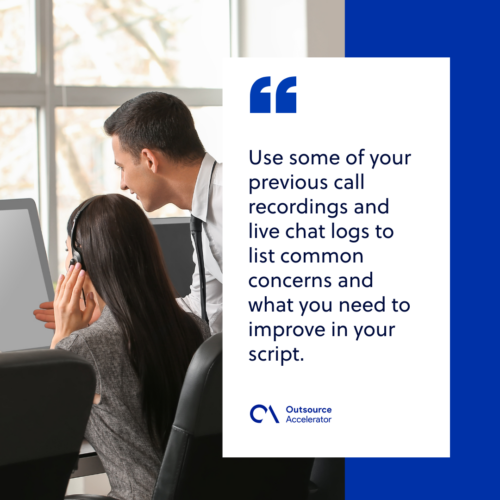
First, understand your customers and their common concerns. While you cannot address all types of customers, you can meet their key needs. So use past call recordings and chat logs to list common concerns and gaps.
Integrate best practices from previous calls
Next, use your call recordings to spot what works. For example, take a call from a happy customer. Then note the best moves the agent made, from tone and wording to the answers.
Draft an impressive introduction
Your opening shapes the impression of your brand. So a strong introduction shows you are ready to help. As a result, it starts the call on the right note. Give your agent’s name and the company early to build a connection. In addition, personalize the greeting for returning customers, then ask about their concern.
Make use of positive reinforcements
Positive reinforcements encourage customers to engage with your agents. So they show the customer made the right call for help. For example, start with a simple “How can I help you today?” During the call, confirm details and ask questions that prompt a “yes.”
Reword negative responses
Find a way to turn a negative reply into a positive one. This matters most when you write a telemarketing script, since you will hear “no” at times. Still, you can turn these into positive actions. As a result, you show empathy. For example, a sincere “I understand” goes a long way.
Be mindful of your language
Always use conversational language with clients. So mind your tone and skip heavy jargon. Remember, your goal is to solve concerns quickly. Because of this, keep answers short and clear. Strong scripts also build on solid customer service skills that agents can lean on.
Apologize sincerely
Sometimes you will face an irate customer. When upbeat lines do not work, win back trust by apologizing first. So offer a sincere apology and show you understand. Then follow it with a clear promise to help. After all, nothing satisfies more than quick action.
Leave room for flexibility
Flexibility keeps your script from sounding canned. While you can write what agents should say, leave room for their own words. As a result, conversations feel better. So agents can handle extra questions, redirects, and interruptions with ease.
End the call on a high note
Before you end a call, make sure you met the customer’s needs. So ask if they have other concerns and if they feel satisfied. You can also offer an upsell when it fits. Finally, wrap up your script with a simple “thank you” and a warm goodbye.
Review and edit your script regularly
Once you draft your script, review and edit it often, even while agents use it. So check recordings that use the current script and note what to improve. In addition, keep customer needs, policy changes, and new channels in mind. As a result, better scripts often lift customer satisfaction over time.

Call center script templates
Crafting a script is not as hard as many think. Besides your own recordings, many free resources and examples can guide your first script. For example, most customer service software offers ready call center scripting software and templates you can edit. These call scripts hold basic outlines and lines for inbound or outbound calls. The right call center agent tools make it even easier to build and share them.
For outsourced teams, coordinate with your provider on the call script to use and how to improve it. All in all, you do not need a fancy script. So long as it lifts customer satisfaction, it does the job.
Call center script FAQs
What is a call center script?
It is a written guide with spiels and common answers for calls. As a result, agents stay clear and consistent.
What is the difference between a script and a call flow?
A script gives fixed lines. Meanwhile, a call flow maps the whole call and lets agents use their own words.
What are the key parts of a call center script?
The core parts are a greeting, purpose, empathy, questions, solutions, and a close. In addition, many add compliance and escalation steps.
How do you make a script sound natural?
Use plain, warm language and leave room to improvise. So agents can adjust to each customer.
How often should you update a call center script?
Review it regularly, even while agents use it. For example, update it after policy changes or new channels.






 Independent





