
How offshore staffing can help improve your business operations


What are the main offshore staffing benefits?
The main offshore staffing benefits are lower costs, faster growth, sharper in-house focus, and quicker turnaround from a large global talent pool. In short, offshore staffing lets you hand key tasks to a skilled team abroad. As a result, you save money and free your core staff for higher-value work.
- Cut labor and hiring costs without lowering quality.
- Scale your team quickly through a ready talent pool.
- Keep in-house staff focused on the work that grows the business.
Running an expanding business can be taxing. This is even harder when you are also looking for new talents for that growth.
Most of the time, companies lack the people and resources to recruit, hire, and train new staff. As a result, this gap opened the door for a fast-growing industry: business process outsourcing (BPO).
Outsourcing happens through onshore, nearshore, or offshore staffing. In each case, you hand a business process or task to an outside company. Among the three, offshore staffing is by far the most common.
What is offshore staffing?
Offshore staffing is a type of outsourcing where a company lets a third party handle some of its work.
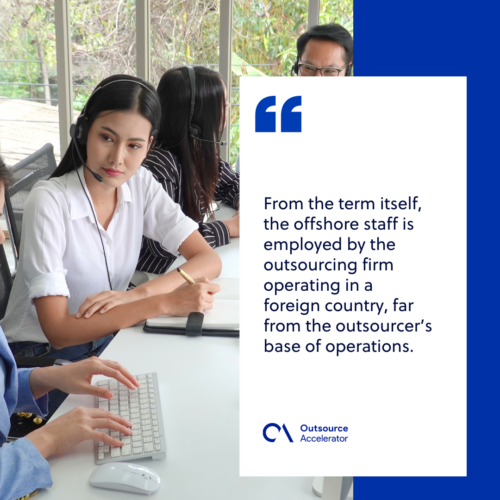
As the name suggests, the offshore staff work for a firm in another country. That country sits far from the outsourcer’s home base.
Outsourcing in the modern sense began around 1950. However, the practice is much older. In fact, it dates back to the 18th century during the industrial revolution.
Take the textile industry as an example. Firms often sourced raw materials from cheaper regions, like India. Then they processed them in low-cost labor markets, such as Scotland.
Much like modern outsourcing, this let textile makers save on both materials and labor. So they spent far less than if they had sourced everything at home.
Onshore vs nearshore vs offshore staffing
The key difference is location. It comes down to where the outsourced company sits.
Onshore staffing means hiring a provider in the same country as the outsourcer. For example, a New York firm might outsource IT to a company in New Jersey. That is onshore outsourcing.
Meanwhile, nearshore staffing means hiring a firm outside your country but still nearby. For instance, a US company might send customer service to a Canadian provider.
Finally, offshore staffing moves a task to a firm both outside and far from your country. For example, an American company might hire a firm in the Philippines, like Outsourced, to run its IT services. That is offshore staffing. To weigh the trade-offs, it helps to compare offshore versus onshore models side by side.
How do businesses benefit from offshore staffing?
Offshore staffing brings many benefits to the table. By choosing the right partner, you can save on costs, work more efficiently, and lift productivity. These are just a few of the wider benefits of outsourcing for a growing firm.
Below are some of the top offshore staffing benefits your business can gain:
Cost reduction
Cost savings are the most talked-about benefit of outsourcing. For example, offshore firms often work in countries with a much lower cost of living. So the savings can be large.
For example, Outsourced operates in the Philippines and hires Filipino professionals for its clients. By partnering with Outsourced, foreign companies fill key roles with skilled Filipino workers.
The country’s low cost of living helps both sides. Outsourcers pay less than they would for local hires. Meanwhile, the workers earn a decent, livable wage. In addition, outsourcers save on recruitment, hiring, training, and other HR costs.
Easier business expansion
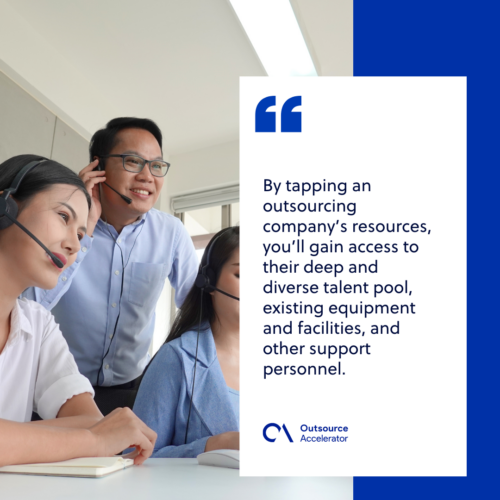
Offshore staffing makes it easier to expand your operations. By tapping a provider’s resources, you gain access to a deep talent pool. You also gain their equipment, facilities, and support staff.
As a result, you skip the slow and costly hiring process. So you can focus on scaling the business instead. For the best results, it helps to follow a few offshore team best practices from day one.
Improves in-house employee efficiency
Handing routine tasks to offshore staff frees your in-house team. As a result, they get more time for the critical parts of their jobs.
For example, staff spend less time on repetitive back-office work. Instead, they can focus on tasks that grow the business, such as marketing strategy.
Faster turnaround time
Most offshore firms will work your preferred hours. Many even run 24/7 with rotating staff. So the work keeps moving around the clock.
In addition, these teams bring experienced professionals to the job. As a result, you get service that matches or beats local quality. In addition, they often use leading tools to deliver quality work on time.
Where can businesses turn for their offshore staffing needs?
The shift to remote work has raised demand for outsourcing, especially in IT. To meet it, many providers have grown in popular hubs like the Philippines. The Philippines remains a top outsourcing destination for good reason.
So you will never be short of options for your offshore staffing needs. Still, you need a partner you can trust to deliver quality work. For a focused search, you can also explore offshore staffing solutions in the Philippines.
If you are thinking about outsourcing, Outsourced is a solid choice. It has been in the business for roughly a decade. Today it ranks among the leading BPO companies in the Philippines.
This ISO-certified company offers a wide range of services across many industries.
Its services include recruitment, logistics support, web development, human resources, telemarketing, graphic design, and even geological services.
If you need outsourcing solutions, reach out to Outsourced for guaranteed quality service you will not regret.
Offshore staffing FAQs
Is offshore staffing only about saving money?
No. Cost savings matter, but they are just one part. You also gain a bigger talent pool, faster scaling, and round-the-clock output.
What tasks can you offshore?
You can offshore many roles. For example, common ones include IT, customer service, accounting, and marketing support. In short, most back-office and support work fits well.
Is offshore staffing safe for data and quality?
Yes, with the right partner. For example, look for clear contracts, strong security, and proof of quality, such as ISO certification. So do your checks before you sign.
How is offshore different from nearshore staffing?
Offshore staff work far from your country, often across the world. Nearshore staff work in a nearby country. As a result, nearshore offers closer time zones, while offshore often offers bigger savings.
Key takeaways
- Offshore staffing means hiring a skilled team abroad to handle key business tasks.
- The top offshore staffing benefits are cost savings, easier growth, sharper focus, and faster turnaround.
- The Philippines remains a leading hub, with firms like Outsourced serving global clients.
- Choose a trusted, secure, and proven partner to get the best results.






 Independent





