
An introduction to 13th month pay law and computation


What is 13th month pay and who gets it?
13th month pay is an extra payment equal to at least one-twelfth of an employee’s basic yearly salary, and in the Philippines the law requires it for rank-and-file staff.
- It equals 1/12 of your total basic salary for the year.
- In the Philippines, employers must pay it on or before December 24.
- However, freelancers and some other workers are not covered by law.
It is that time of year again that every employee looks forward to: the BER months. So the countdown to Christmas begins, with cold nights, carols, and the much-awaited 13th-month pay. After all, who would not welcome extra money for the holidays? Still, not everyone gets this perk. For example, freelancers and self-employed workers often miss out. In this article, we explain 13th month pay, the law behind it, and why employers should share it with freelancers too.
What is the 13th-month pay?
13th month pay is simply extra pay given to employees. In most cases, it equals at least 1/12 of a worker’s total basic salary for the year. Rules vary by country, though. For example, the US and UK do not require this bonus. Most Latin American countries, meanwhile, pay it in up to three installments. Only Chile gives a “customary thirteenth-month pay,” either as one lump sum or in two parts, in September and December.
13th-month pay law in the Philippines
The rule comes from Presidential Decree No. 851. Under it, 13th month pay is a required cash benefit for all qualified employees. So employers must pay it on or before December 24. In this way, staff can properly celebrate Christmas and New Year. Later, an amendment made clear that it covers all rank-and-file employees.
The difference between the 13th-month and 14th-month pay
The 13th month pay differs from 14th-month pay or a Christmas bonus. In the Philippines, the 13th month pay is required by law. The 14th-month pay, meanwhile, depends on each company’s own practice. So employers do not have to give bonuses at all. Even when they do, it may come as gift certificates or Christmas packages. Still, some business process outsourcing employees get both 13th and 14th-month pay on top of incentives.
Who is qualified to receive 13th-month pay?
Section 3 of the rules on 13th month pay covers all local private-sector employees. However, there are a few exceptions:
- Those with distressed employers. For example, firms with steady losses may ask the Department of Labor and Employment for an exemption.
- Household and personal-service workers, such as helpers, family drivers, and gardeners.
- Workers paid purely on commission, per task, or by a fixed amount for set work, such as freelancers.
Computation of 13th-month pay based on employment status
Under the decree, 13th month pay equals one month’s salary, or 1/12 of a worker’s yearly salary. So this applies to rank-and-file staff with more than one year of service. For those with less than a year, they get a pro-rated amount. Still, it must be at least one thousand pesos (Php 1,000.00), based on their length of service that year.
For example, here is a table for an employee with a PHP 20,000 basic monthly salary.
| Basic pay (monthly salary) | Length of tenure (in months) | 13th month pay* (amount to be received) |
| PHP 20,000.00 | 1 | PHP 1,667.00 |
| PHP 20,000.00 | 6 | PHP 10,000.00 |
| PHP 20,000.00 | 12 | PHP 20,000.00 |
*13th month pay = (basic pay * length of tenure) / 12
This benefit does not cover other allowances and perks, such as:
- Cost of living allowances
- Unused vacation and sick leave credits
- Holiday pay
- Night shift differential
- Overtime pay
- Etc.
In addition, the exact math changes with a worker’s status. So let us look at each case next.
Minimum wage earners
Minimum wage earners can still get 13th month pay, whatever their status. However, unpaid absences and shutdowns can lower the amount. For guidance, DOLE released an updated sample computation for the basic wage in NCR.
Contractual employees
Contractual employees in the Philippines are fully protected by law. Under Section 8 of the DOLE Department Order No. 18-A, seasonal, reliever, and temporary staff get rights under the Labor Code. So they qualify for 13th month pay and other benefits. In practice, the math works like it does for regular workers. As a result, they get either a pro-rated amount or a full month’s basic salary.
Managerial employees
Managers are not entitled to 13th month pay by law. However, employers may still give it if they choose. In addition, managers can get other perks, such as Christmas bonuses and 14th-month pay.
Government employees
At first, the 13th month pay law only covered the private sector. So government workers do not qualify for this exact benefit. Still, that does not mean they get nothing. In fact, they receive the following perks instead.
14th-month pay
Government agencies may give 14th-month pay at their discretion. So staff can get up to a full month’s basic salary, based on the approved memorandum circular.
Bonuses
Government staff can get mid-year and year-end bonuses once they meet the minimum service needed. In effect, these two bonuses match the 13th month pay in the private sector. Performance-based bonuses, meanwhile, use a different formula. After all, they depend on each worker’s output and role.
Resigned or terminated employees
According to the Bureau of Working Conditions, resigned or terminated staff still qualify for 13th month pay “at any time before the time of payment.” Based on its site, the pay is “in proportion” to their stay that year. So the amount can be worked out in two ways:
- From the start date. For staff below one year of service, count from their first day that year to their exit date.
- From the date of the last 13th-month pay. For tenured staff, count from the last payout to their exit date.
Is the 13th month pay taxable?
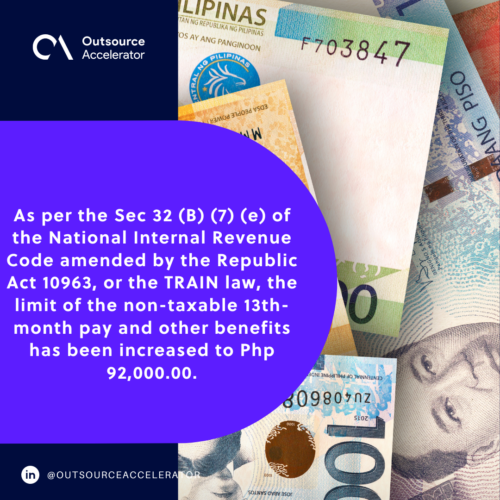
Whether your 13th month pay is taxable depends on the amount. The good news is the cap is high. Under Sec 32 (B) (7) (e) of the National Internal Revenue Code, as amended by Republic Act 10963, or the TRAIN law, the tax-free limit is Php 90,000.00. So this ceiling also covers Christmas bonuses and other perks.
Failure to give 13th-month pay to employees
Firms that fail to pay 13th month pay can face legal charges, unless they file for an exemption. Under the rules, employers must report compliance to DOLE by January 15 of the next year. If they do not pay, staff may file a money claims case at any DOLE branch. From there, the case follows the Labor Code and the rules of the National Labor Relations Commission. As a result, the unpaid 13th month pay becomes due and demandable. BPO firms are not exempt either. After all, their staff are based in the Philippines, so Philippine law still applies.
How about giving the 13th month to freelancers?
The law does not require it, so why not consider it anyway? Freelancers and remote workers may not be on your payroll. Still, like any employee, they give real skills and time to your business. In addition, they often work without the usual perks. So a little extra money would mean a lot for the holidays. For example, it can help with the coming Philippine holidays. In short, we encourage employers to give freelancers a 13th month payment as a thank-you for their hard work.
Frequently asked questions about 13th month pay
How is 13th month pay computed?
The formula is simple: basic pay times length of service, divided by 12. So a full year of work equals one month’s basic salary. For a partial year, you get a pro-rated share.
When should 13th month pay be released?
Employers must pay it on or before December 24 each year. So staff have the money in time for the holidays. Some firms also split it into two releases.
Is 13th month pay taxable in the Philippines?
Only the part above Php 90,000 is taxable. This cap covers your 13th month pay plus other bonuses. So most workers pay no tax on it.
Do resigned employees still get 13th month pay?
Yes, they do. The amount is pro-rated to the time they worked that year. So they still receive their fair share.
Are freelancers entitled to 13th month pay?
No, the law does not require it for freelancers. However, employers may still give it as a goodwill gesture. In many cases, it helps keep good freelancers loyal.
Key takeaways
- 13th month pay equals 1/12 of a worker’s basic yearly salary.
- In the Philippines, employers must pay rank-and-file staff on or before December 24.
- The tax-free ceiling for 13th month pay and other bonuses is Php 90,000.
- Resigned staff still get a pro-rated share for the year.
- Freelancers are not covered, but employers can still choose to reward them.






 Independent





