
A quick guide on the average salary in Thailand

What is the average salary in Thailand?
The average salary in Thailand is roughly THB 15,700 (about US$480) per month for an individual worker, while average household income sits near THB 28,308 (about US$865) per month.
- Pay is higher than in the Philippines and India. Still, it sits far below the United States, Hong Kong, and Singapore.
- Education, location, role, and industry each shape how much a worker takes home.
- Even so, outsourcing to Thailand can be up to 70% cheaper than hiring in developed markets.
Thailand is one of the largest economies in Asia. As a result, the average salary reflects a broad workforce. It spans tourism, manufacturing, and fast-growing digital services. The country is also known to welcome ex-pats and migrant workers. For this reason, it has become a rising outsourcing hub for low-cost manufacturing and facilities management.
The average salary in Thailand today
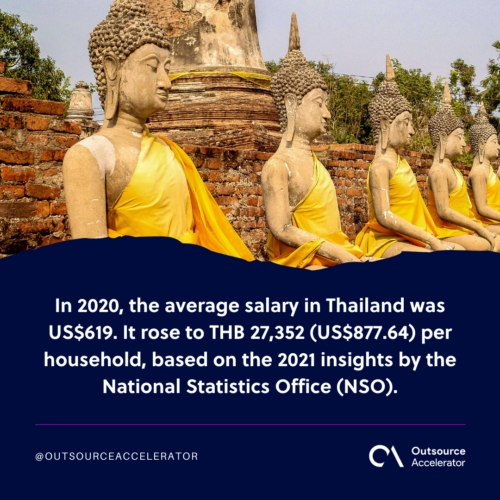
Recent figures point to an average monthly wage of about THB 15,700 (roughly US$480) per worker. Household income tells a similar story. It averaged THB 28,308 per month in the latest survey. That is a slight dip from THB 29,030 two years earlier. In fact, it was the first decline in six years. The main reason was that earned income softened across the labor market.
Thailand still ranks ahead of the Philippines in overall average global wages. Wage committees also keep reviewing pay floors. As a result, the average salary in Thailand is expected to edge higher over time.
The elements that affect the average salary in Thailand
Several factors shape a worker’s income in Thailand. For example, the elements below each move pay up or down.
Educational background
As in most countries, education level in Thailand matters when you negotiate a good salary.
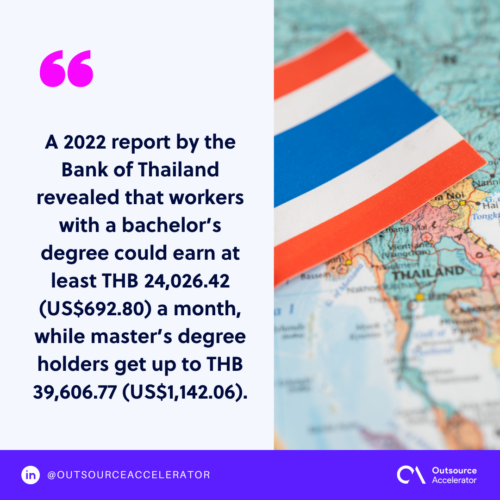
Data from the Bank of Thailand shows a clear gap. Workers with a bachelor’s degree can earn around THB 24,000 a month. Master’s degree holders, meanwhile, reach roughly THB 39,600.
Non-degree holders can still earn about THB 15,600 monthly. However, most have fewer chances to grow their earnings than college graduates do.
Location and the average salary in Thailand
In addition, the average wage in Thailand varies by region. Large cities host more corporate and tourism activity. As a result, wages there tend to sit above the provinces.
Thailand’s daily minimum wage now ranges from THB 337 to THB 400 by province. For example, Bangkok reached THB 400 per day in mid-2025. In short, here is a snapshot of daily minimum wage rates in major locations.
| Location | Daily minimum wage (THB / approx USD) |
| Bangkok | THB 400 (US$12.30) |
| Chonburi and Rayong | THB 400 (US$12.30) |
| Phuket | THB 400 (US$12.30) |
| Chiang Mai (Muang district) | THB 380 (US$11.70) |
| Bangkok’s surrounding provinces | THB 372 (US$11.45) |
| Narathiwat, Pattani, and Yala | THB 337 (US$10.35) |
Cost of living
The cost of living in Thailand runs close to US$690, based on national statistics. Per Numbeo, rent and expenses in Thailand are up to 20% higher than in the Philippines. Still, they stay lower than in the United States.
Bangkok, Chiang Mai, and other Thai cities remain more affordable than many Asian hubs. As a result, they keep drawing remote workers and international employers.
Roles and expertise
Salaries in Thailand vary widely by role and expertise. For example, surgeons, judges, and lawyers are among the highest-paid professionals in the country, according to SalaryExplorer. Software engineers, meanwhile, earn well above the national average.
In addition, here are indicative salaries for other professions in the country, based on Payscale data.
| Profession | Average pay (monthly) |
| Project Manager (General) | US$2,497 |
| Marketing Manager | US$2,380 |
| SAP Consultant | US$1,625 |
| Business Development Manager | US$2,311 |
| Software Developer | US$1,301 |
| ESL Teacher | US$899 |
| Graphic Designer | US$863 |
| Customer Service Agent | US$1,044 |
| Team Leader (IT) | US$2,995 |
Industry
Different industries in Thailand offer different pay scales. Medical services, IT, and banking have long ranked among the top payers. Meanwhile, digital disruption keeps pushing technology roles up the list.
Bank of Thailand data backs this up. Professional, scientific, and technical work carries one of the highest average salary ranges. For example, professionals in the private sector can earn well over US$1,000 per month. Public sector workers, by comparison, earn less on average.
The JobsDB Thailand Salary Report ranks the highest-paying industries by seniority.
| Industry | Officer | Supervisor | Manager |
| Information Technology (IT) | US$1,276 | US$2,077 | US$2,896 |
| Professional Services | US$1,220 | US$1,983 | US$2,822 |
| Telecommunication | US$1,198 | US$2,083 | US$2,936 |
| Medical Services | US$1,158 | – | – |
| Insurance | US$1,082 | US$1,979 | US$2,815 |
| Banking | US$1,167 | US$2,000 | US$2,932 |
| E-commerce | US$1,095 | US$2,010 | – |
| Engineering | US$1,104 | – | US$2,631 |
How the average salary in Thailand compares globally
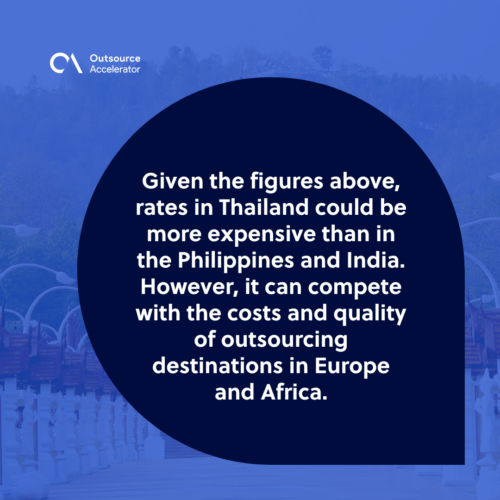
Given the figures above, pay in Thailand can beat the Philippines and India. However, it can still compete with the cost and quality of outsourcing destinations in Europe and Africa.
At the same time, outsourcing to Thailand can be up to 70% cheaper than in developed countries. In short, here is how Thailand fares worldwide on average salaries.
| Outsourcing destination/market | Average salary (monthly) |
| Thailand | US$865 |
| Poland | US$1,348 |
| South Africa | US$1,503 |
| Singapore | US$3,516 |
| United Kingdom | US$4,071 |
| United States | US$4,626 |
| Australia | US$6,992 |
Outsourcing to Thailand: advantages and considerations
Thailand is gaining ground as an outsourcing hub for logistics management services. For example, companies are drawn to low-cost manufacturing. As a result, the country can compete with China as some firms diversify their supply chains.
In addition, quality infrastructure in Thailand costs less. This makes it a solid option for setting up business operations. However, outsourcing to Thailand still has trade-offs to weigh.
- English proficiency. Thailand ranks 106th out of 116 in the global English proficiency index. As a result, the country still needs ESL teachers and English-ready talent for business roles.
- Labor supply. Thailand has moved to allow more migrant workers in, largely because of shortages in manufacturing.
- Cybersecurity. Data protection is still maturing. Thailand’s Personal Data Protection Act is now in force. Still, enforcement and compliance keep developing.
Because of these factors, companies that want to outsource to Thailand should plan with care. First, research the market thoroughly. Next, partner with a reliable service provider to protect the quality and security of outsourced work.
Key takeaways
- The average salary in Thailand is about THB 15,700 (US$480) per month per worker, with household income near THB 28,308 (US$865).
- Daily minimum wages now range from THB 337 to THB 400, with Bangkok at the top of the scale.
- Education, location, role, and industry are the biggest drivers of pay.
- Thailand costs more than the Philippines and India. Still, outsourcing there can cut labor costs by up to 70%.
- Weigh English proficiency, labor supply, and data protection before you commit.
Frequently asked questions
What is the average wage in Thailand?
The average wage in Thailand is roughly THB 15,700 a month, or about US$480, for an individual worker. Average household income sits nearer THB 28,308 a month, about US$865.
What is the average salary in Thailand in USD?
About US$480 a month per worker. That is higher than the Philippines and India, and well below the United States, Hong Kong, and Singapore.
What is the average Thai salary?
Around THB 15,700 a month. Education, location, role, and industry each move the figure, and outsourcing to Thailand can still run up to 70% cheaper than hiring in developed markets.
What is the average monthly salary in Thailand?
The average worker in Thailand earns roughly THB 15,700 (about US$480) per month. Household income is higher, near THB 28,308 (about US$865) per month. That is because many households have more than one earner.
What is the minimum wage in Thailand?
The daily minimum wage ranges from THB 337 to THB 400 by province. For example, Bangkok, Phuket, Chonburi, and Rayong sit at the THB 400 top tier. The southernmost provinces, by comparison, sit at THB 337.
Is Thailand cheaper than the Philippines for outsourcing?
Not usually. Salaries and living costs in Thailand tend to run higher than in the Philippines and India. However, Thailand can still be up to 70% cheaper than hiring in the United States, the United Kingdom, or Australia.
Which industries pay the most in Thailand?
Information technology, professional services, telecommunications, banking, and medical services rank among the top payers. In addition, specialized roles such as software engineering command above-average pay.
Is English proficiency a concern when hiring in Thailand?
It can be. Thailand ranks low on the EF English Proficiency Index. As a result, employers often screen carefully for English-ready staff or invest in language training for customer-facing roles.






 Independent





