
BPO and the Philippine economy


How does BPO drive the Philippine economy?
The BPO industry is a core engine of the Philippine economy, earning about $40 billion in export revenue and contributing more than 8% of national GDP in 2025.
- The sector employs close to 1.9 million Filipino workers.
- The Philippines is widely seen as the BPO capital of the world.
- Strong English skills, low costs, and a large talent pool keep work flowing in.
When it comes to outsourcing, the Philippines stands out, especially in the West. Its long history with Western nations makes it easy for Filipinos to work with those markets. At the same time, they keep their own traditions and values. As a result, the language and culture gap at work stays small.
The Philippine BPO industry has also proven it can adapt fast. It handled the shift to remote work with ease. Because of this, many experts see strong, steady growth ahead.
So this article looks at how BPO fuels the Philippine economy. In addition, it covers the country’s rise as a global BPO leader and the future of outsourcing.
The impact of BPO on the Philippine economy
The Philippine BPO industry was born in 1992. Early on, it employed nearly a million workers and created a strong ripple effect. In 2005 alone, it added about 2.4% to the country’s GDP. The next year, the economy grew 5.4%, and the rising BPO sector helped drive that gain.
Over time, more foreign investors moved in. The Philippine Economic Zone Authority (PEZA) helped by easing space and tax rules for new firms. So it became simpler to set up shop and hire local talent. For many companies, this is a big reason outsourcing to the Philippines makes sense.
The Philippines as the BPO capital of the world
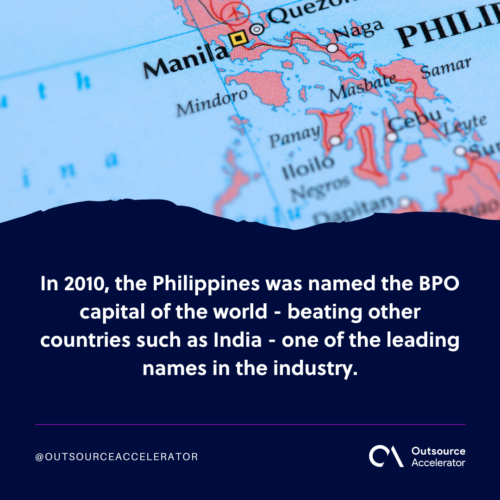
In 2010, the country earned the title of BPO capital of the world. In fact, it edged out other leaders such as India. Meanwhile, Filipino agents are known as warm, clear communicators who connect well with global customers.
For example, that skill shows across many services, from medical transcription to sales. As a result, Filipino teams bring in strong revenue for the firms they serve. Their focus on value and purpose is a key reason the industry keeps booming.
By 2013, the sector generated $13 billion in export revenue. That was a 1000% jump from $1.3 billion in 2004. All of it flowed from the country’s Business Process Outsourcing (BPO) powerhouse. Even so, the best was still to come.
WTO recognition in the industry
A report from the World Trade Organization highlighted the industry’s value to the Philippine economy. It pointed to the sector’s big role in jobs and growth. According to that report, BPO added 7.3% to GDP growth.
Since then, the sector has only grown larger. Today, it is firmly a multibillion-dollar industry. So its weight in the economy keeps rising each year.
Bright future of the BPO industry
As the BPO industry expands, the Philippine economy tends to grow with it. Years ago, the Philippines ranked third among the fastest-growing economies in Asia. Since then, it has held a strong lead among ASEAN economies.
In addition, the sector has shown real resilience. When many firms cut costs, they turned to outsourcing for help. As a result, remote hiring in the industry surged. Meanwhile, the government keeps a positive view of outsourcing as a growth driver.
The latest figures back this up. IBPAP reported that the sector closed 2025 with about $40 billion in export revenue. It also employed close to 1.9 million workers. On top of that, the industry now contributes more than 8% of national GDP. So its future looks brighter than ever. For a deeper view, see where the Philippine BPO industry stands today.
Business Process Outsourcing in the Philippines
Finally, there is a clear link between the country’s economy and its growing BPO sector. In fact, when the economy gains, outsourcing is often a big reason why. You can read more in the Strong Future of Outsourcing – white paper.
In addition, investors stay confident in the Filipino workforce. After all, hardworking local teams power strong results for global firms. So it is often a win-win for both sides. To weigh the wider gains, review the key benefits of outsourcing for growing companies.
In short, BPO plays a central role in the Philippine economy. As the sector thrives, so does the country. For buyers new to the market, a guide to call center services in the Philippines is a good place to start.
Frequently asked questions about BPO and the Philippine economy
How much does BPO contribute to the Philippine economy?
The BPO sector earned about $40 billion in export revenue in 2025. It also contributes more than 8% of the country’s GDP. So it is one of the largest sources of foreign income.
How many people work in the Philippine BPO industry?
The industry employed close to 1.9 million workers in 2025. IBPAP projects the headcount to reach about 1.97 million jobs by 2026.
Why is the Philippines called the BPO capital of the world?
The country earned the title in 2010. In fact, its edge comes from strong English skills, a large talent pool, and a warm service culture that global customers value.
Is the Philippine BPO industry still growing?
Yes. The sector grew about 5% in 2025, above the global average of roughly 3%. So it continues to outpace the wider market.
What services do Philippine BPO firms handle?
They handle customer support, finance and accounting, IT, healthcare back-office, and more. In recent years, work has also shifted toward higher-value analytics and tech roles.
Key takeaways
- BPO is a core engine of the Philippine economy, earning about $40 billion in 2025.
- The sector contributes more than 8% of GDP and employs nearly 1.9 million people.
- The Philippines has been the BPO capital of the world since 2010.
- Strong English skills, low costs, and a deep talent pool keep work flowing in.
- Steady growth suggests a bright future for both the industry and the country.






 Independent





