
How to be a business development representative in 2026


What does a business development representative do?
A business development representative finds new leads, opens conversations with prospects, and passes qualified leads to the sales team.
- They act as the first point of contact for clients and partners.
- They run outreach and lead generation to bring in new revenue.
- They team up with sales staff to turn interest into real deals.
Every company needs a business development representative, and the role sits in almost every industry. So if you want a clear career path, this guide is a good place to start. They serve as a company’s first point of contact with clients, partners, and patrons. In addition, they market the company and its brands to spark more interest and more revenue.
Digital Consulting PH provides advisory services for business development. As a result, clients get help to get ahead in their approach.
What is a business development representative?
Business growth relies on the steps a company takes to chase new trading strategies. A business development representative (BDR) owns much of that work. First, they plan outreach and run lead generation activities. They work alongside sales personnel or sit inside the sales team itself. So the main goal of a business development representative is simple. They find opportunities and pass qualified leads to the salesperson.
The role often overlaps with sales development representatives, who focus on the same top-of-funnel work. Because of this, many teams treat the two titles as close cousins.

Without them, a company can stall early. In short, it stays stuck with its first goals and never grows past them.
Business development representative vs B2B customer representative
Some duties overlap, but there are key differences between a BDR and a B2B customer representative. A BDR reaches out to new clients and partners to bring in more sales. However, a B2B (business-to-business) customer representative handles concerns, complaints, and questions about a brand or product. So one role hunts for growth. The other keeps current clients happy.
Inbound and outbound work
BDRs touch both sides of the sales floor. For example, they answer warm inquiries and also chase cold prospects. If you want to grasp the split, read our guide on inbound and outbound sales. Meanwhile, a strong grasp of cold calling best practices helps a business development representative book more meetings.
Skills you need to be a business development representative
Most online learning platforms like Coursera, edX, MasterClass, and Skillshare offer short courses for new BDRs. So if you want to upskill, you can start there. Next, focus on the core skills below.
Communication skills
Every professional needs solid communication skills. You use both spoken and written words each day. For example, you talk with your team and with clients. If you feel unsure here, you can sharpen these skills. First, take formal training. Then practice on your own and ask a mentor for feedback.
Knowledge of marketing and sales strategies
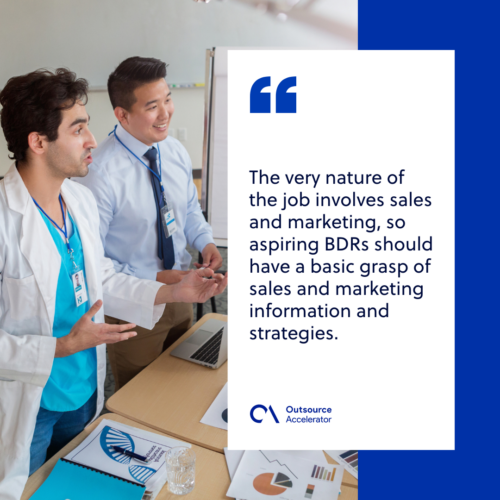
As a business development representative, you bring new activity into the company. The job mixes sales and marketing every day. So aspiring BDRs need a basic grasp of sales and marketing information and strategies. In addition, the benefits of a good CRM make daily outreach far easier to track.
Organizational skills
BDRs often keep a busy calendar and a full day ahead. So being organized pays off fast. As a result, you work with more focus and get more done.
Technological know-how
Technology helps at work, whether we like it or not. To do well as a business development representative, you need to feel at ease with tech. After all, the sales floor is full of computers and other tools you need for the role.
Business development best practices
Like any job, this role has its own code of conduct. So a few best practices help you stand out.
Working smart
Working smart means you stay resourceful. In short, you use the tools you have to do the job well. You aim for quality, not just volume. For example, some pros do not work a full nine to five. They finish tasks in fewer hours because they work smart.
Staying professional
Sometimes a BDR faces a hard task or a tough client. However, they must stay calm and professional. Remember, a company rep should mirror what the brand stands for. So they often build brand awareness and spread the word.

Studying your product and brand
Deep product knowledge is a big part of the job. So you must know the company, its products, and its brand well. As a result, tenured BDRs never fumble when a client asks a product question.
A business development representative’s impact on a company
A business development representative brings in revenue and new connections. That is their core impact. Without them, a company struggles to link up with other firms. For that reason, many teams also choose to outsource sales reps to scale outreach at a lower cost.
Frequently asked questions
What is the difference between a BDR and an SDR?
The two roles look alike. A BDR often chases new markets and partners. An SDR usually qualifies inbound leads. Still, many companies use the titles for the same top-of-funnel work.
Do you need a degree to become a business development representative?
No, a degree is not always required. Many BDRs start with strong communication skills and short courses. So drive and coachability matter more than a single diploma.
What tools does a business development representative use?
Most BDRs use a CRM, email tools, and call software. In addition, they rely on data and lead lists. These tools help them track outreach and follow up on time.
Is business development representative a good career?
Yes, it can be a strong start. The role builds sales and people skills fast. As a result, many BDRs move up into account executive or manager roles.
Can the BDR role be outsourced?
Yes, many firms outsource lead generation and outreach. So they gain trained reps without the full cost of in-house hires. This works well for teams that need to scale quickly.
Key takeaways
- A business development representative opens doors and feeds qualified leads to sales.
- Core skills include communication, sales knowledge, organization, and tech comfort.
- Best practices mean working smart, staying professional, and knowing your product.
- The role drives revenue and new partnerships, so its impact is direct.
- Teams can build the role in-house or outsource it to scale faster.






 Independent





