
15 rules of business etiquette to improve your reputation


What is business etiquette and why does it matter?
Business etiquette is the set of manners and behaviors that build trust and a good reputation at work.
- It helps people feel safe, respected, and comfortable on the job.
- It builds trust with clients, colleagues, and managers.
- Poor etiquette can cost you clients and your good name.
With more remote and hybrid work, many old habits have slipped. Nowadays, some people work from bed in pajamas and a plain shirt. However, more companies are moving back to the office. So new hires must know business etiquette when they meet clients and colleagues.
Learning business etiquette does not have to be hard. Below, we cover simple rules you can apply to lift your reputation at work.
What is business etiquette?
Business etiquette is a set of manners and behaviors seen as acceptable at work. It helps build a good setting for professionals. As a result, people feel safe and at ease on the job.
Business etiquette, much like personal manners, shifts with the times, technology, and lifestyle. It splits into a few subsets that cover different settings:
- Workplace
- Communication
- Dining
- Meeting
- Professionalism

Why is it important?
American author and etiquette expert Emily Post defines the aim of business etiquette as “a framework for building successful professional relationships and showcasing [your] business presence.”
Business etiquette rests on two ideas: honesty and respect. By following these behaviors, professionals show clients and employers that they respect them. Further, strong etiquette matters for the reasons below.
- Boosting professional confidence. Good etiquette lifts both your confidence and your client’s. In turn, this builds trust and makes each deal smoother.
- Avoiding misunderstandings. Your team can cut mix-ups by following etiquette. This helps build strong workplace communication and teamwork.
- Maintaining a good work environment. As a result, you keep a healthy setting. Staff feel free to share ideas and feedback. Strong workplace collaboration often follows.
What is considered unprofessional behavior?
You can lose clients and credibility when you skip business etiquette. Worse, you may earn a bad name if others call you “unprofessional.” Some behaviors are not acceptable, or even legal, at work. So watch out and avoid the following:
- Going to the office under the influence
- Leaving people waiting for long
- Badmouthing co-workers, managers, or executives
- Attacking someone’s race, gender, or religion
- Committing assault towards another person
- Breaching confidentiality
- Taking part in illegal practices, inside or outside the company
15 rules of business etiquette to live by
First impressions matter in building client relationships. In the first few seconds, your client forms an image of you. So be ready to show your manners even before you meet.
Business etiquette can vary by country and culture. However, these basic rules are a strong place to start.
Always arrive on time
Whether in person or online, arrive on time and do not keep people waiting. But this does not mean you should arrive on the dot.
Instead, give yourself time to settle and prepare. Arriving on the dot can make you look rushed. For some, around 15 minutes early is ideal.

Wear appropriate attire
Dress appropriately, no matter the setting. An online meeting at home does not give you a free pass to wear sleepwear on camera.
The same goes for meeting people in person. So groom yourself and dress well for any professional. For example, a neat coat, good pants and shoes, and clean hygiene make a strong start.
Don’t forget to shake hands
A handshake shows respect and interest. A good handshake is firm, with proper body language and eye contact.
Some people still prefer to avoid shaking hands. Still, there are other ways to show your interest. For example, you can offer a soft bow or a nod and smile.
Pay attention
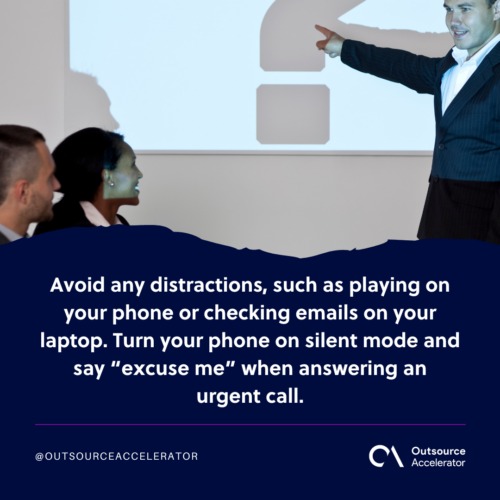
As much as you can, give full attention to the person you are with. Avoid distractions like your phone or your laptop. So turn your phone on silent and say “excuse me” for an urgent call.
Your body language shows attention too. Make it a point to face the speaker and avoid looking around.
Be mindful of names and salutations
Names and salutations shape your first introduction. In a meeting, give your first and last names.
You should also learn your clients’ names, above all when you meet more than one person. So do not be afraid to ask how to say a name. This shows you care to know them.
Let another speaker finish what they are saying
It is rude to interrupt a speaker, whether online or in person. So let them finish first.
Instead, keep a pen and paper ready. Note what you want to ask or add, then bring it up after. That way, the speaker can share fully without being cut off.
Be careful of the language you use
Some forms of language do not fit a professional setting. For example, avoid shortcuts like “tnx” in emails unless your team allows them.
Language can also shift by workplace. So listen to how others speak formally, then try to match it. Strong business communication starts with clear, fitting words.
Introduce your companion to others
When you bring a colleague, do not let them feel left out. Introduce them with their name and role.
Proper introductions help them feel at ease. As a result, this lifts their confidence and builds rapport with clients.
Watch your table manners
You may get invited to a lunch, dinner, or after-hours meetup. This calls for good table and meal manners.
For example, avoid alcohol unless the whole group agrees to order drinks. Also, do not bring smelly food that could bother clients. In short, mind your manners at the table beyond just the fork and knife.

Avoid office gossip and rumor-mongering
Gossip and rumors hurt the victim and the person spreading them. So avoid office gossip as much as you can, above all about a client or manager.
At the same time, skip eavesdropping and anything that wastes time. Doing so helps eradicate a negative work environment and lifts your culture. It also protects workplace productivity.
Watch your tone
Your tone shows in both speech and writing. So watch the tone of your voice and your emails to avoid sounding harsh.
At the same time, do not sound “too soft,” or people may think you are shy.
Respect shared spaces and items
Everyone dislikes a thief, whether of lunches or office items. So avoid taking anything without permission, even small items like scissors.
Also, respect the space you share with coworkers. An open office does not let you invade their personal space or talk nonstop.
Stick to business-related topics as much as possible
Try to avoid two topics with colleagues or clients: religion and politics. They can be touchy and may sour a new relationship.
So stick to business and company topics as much as you can. This helps you avoid conflict between both sides.

Reread your email before sending
There is also an email etiquette in today’s business world. Before you click send, check for grammar and spelling errors and your tone. Even though Gmail lets you undo a send, a double-check is still best.
After all, you do not want your reader to see errors and think you are careless.
Always acknowledge and say “thank you!”
Lastly, always acknowledge the speaker or the email you got and say “thank you.” Some experts even suggest thanking twice: once after the meeting and again the next day.
Saying “thank you” is the best way to close a meeting. In addition, it makes people look forward to working with your company.
How to improve your business etiquette
Business etiquette can be learned over time. All it takes is willingness to learn and apply good manners at work. So use these steps to improve.
- Build emotional intelligence. This gets easier when you consider the people around you. Weigh their feelings and situations, then find ways to respect them. It is one of the core soft skills for business growth.
- Join professional networks. Join groups that show you the etiquette they practice at work. In turn, this supports your professional development goals.
- Encourage others to practice basic etiquette. There are many ways to instill good etiquette in your team. For example, call it “customer care” or “client interaction protocols” to engage your team.
Business etiquette FAQs
What are the basics of business etiquette?
The basics are respect, honesty, and good manners. For example, arrive on time, dress well, listen fully, and say thank you. These habits build trust fast.
Why is business etiquette important at work?
It builds trust and a strong reputation. It also cuts mix-ups and keeps a healthy work setting. As a result, deals and teamwork go smoother.
What counts as unprofessional behavior?
Examples include gossip, poor timekeeping, and breaching confidentiality. Harassment and illegal acts are far worse. So avoid all of these at work.
How can I improve my business etiquette?
Start by building emotional intelligence. Next, join professional networks and watch how others act. Finally, practice good manners each day.
Key takeaways
- Business etiquette builds trust, respect, and a strong reputation.
- Simple habits like timeliness and attention make a big impact.
- Watch your language, tone, and shared spaces at work.
- Avoid gossip, and stick to business topics with clients.
- You can learn etiquette over time with practice and feedback.






 Independent





