
Can claims processing outsourcing help insurance companies?


Can claims processing outsourcing help insurance companies?
Yes. Claims processing outsourcing lets insurance firms cut costs, speed up claim handling, and lift service quality at the same time.
- It moves claim checks and verification to a skilled third-party team.
- As a result, your in-house staff can focus on core work.
- It also brings in proven tools that make claims faster and more accurate.
Claims processing outsourcing (CPO) is a fairly new model for insurance companies. So it helps to know how it works before you try it.
Many firms now use it to lower operating costs and raise service levels. If you are new to this model, you may still wonder what it really means. Here is a quick overview.
Claims processing definition
Claims processing is the way an insurer checks the truth, merit, and details of a client’s insurance claims. First, a healthcare provider sends a claim request to the insurer. Then the insurer reviews it step by step.
If the claim is valid and fits the client’s plan, the provider can get paid in full or in part. However, the insurer can deny the claim if it is invalid, duplicated, forged, or outside the contract. This review sits at the heart of the claims adjudication process.

What is claims processing outsourcing (CPO)?
The term was first coined by the International Association of Insurance Supervisors (IAIS). In short, claims processing outsourcing (CPO) hands the handling and checking of insurance claims to a third-party provider.
Firms use it most when claim volumes are high. Such work needs a lot of people and technology. So an outside team can help clear the backlog. As a result, you finish all insurance claims on time.
Why should you outsource insurance claims processing?
Farming out claims processing gives businesses many gains. For example, it makes the process faster. In addition, it lifts the efficiency of your other in-house services.
The next section covers these gains in detail.
Benefits of claims processing outsourcing
Claims processing is a core part of any insurer’s work. Still, it is also slow and takes a lot of time. So there are many reasons to outsource it. Here are the main ones.
Stress-free process
Outsourcing gives you a smooth, stress-free process. It also speeds up the claiming cycle. As a result, claimants face fewer delays and shorter wait times.
Improves customer experience
Client-facing firms have a lot on their plate. People count on you for fast, professional help. They also want you to listen and support their needs.
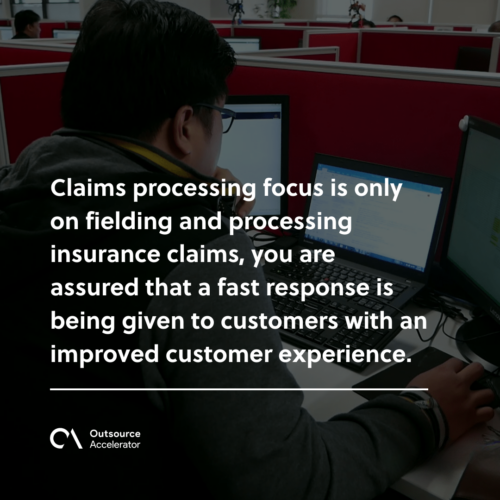
Claims processing teams can add a human touch to your service. Because their focus is only on claims, customers get a fast reply and a better customer experience. As a result, clients feel happier and raise fewer complaints.
High success rate
Outsourcing firms run dedicated claims teams. So you avoid repeat work and aim for one-time success. In addition, these teams know how to process claims in a fast, accurate, and timely way. Their trained staff make sure each claim is handled well.
Cost-effective
Insurance claims need a lot of time and resources. However, BPO firms already have claim teams in place. So you can skip the cost of hiring extra in-house staff.
These providers also bring their own tools and gear. As a result, you save on office space, computers, software, and other overhead. All you need to share is the list of clients and claims to process. Then you are good to go. This is one reason healthcare BPO keeps growing.
Productivity increase
Outsourcing claims work frees up your local team, just like other delegated tasks. So they can focus on their own roles inside the company.
In addition, handing the bulk of claims to a partner gives you room to breathe. As a result, you can point your staff toward other key parts of the business.
Factors to consider when outsourcing claims processing services
You should weigh a few factors before you outsource insurance claims. This keeps your journey smooth. Here are the main ones.
Service level agreement
Service level agreements, or SLAs, are among the most vital documents in any partnership. They spell out duties, service quality, and provider availability.
Healthcare providers must take extra care here. After all, they face the bulk of claim submissions. So draft SLAs with no gray areas. In fact, hiring a lawyer to review the SLA is wise. As a result, you avoid legal trouble later.
Technologies used
Outsourcing insurance and medical claims cuts the time it takes to process claim data. This gain comes from strong industry tools.
These tools streamline claims processing. Well-known options include Claimable, Waystar, and QuickCap. So claim forms become easier, quicker, and more accurate.
Some tools work across many industries. However, the best ones are built for a single sector, such as Waystar for medical claims. As a rule, sector-specific software beats a generalist tool in its own field.
Risks management
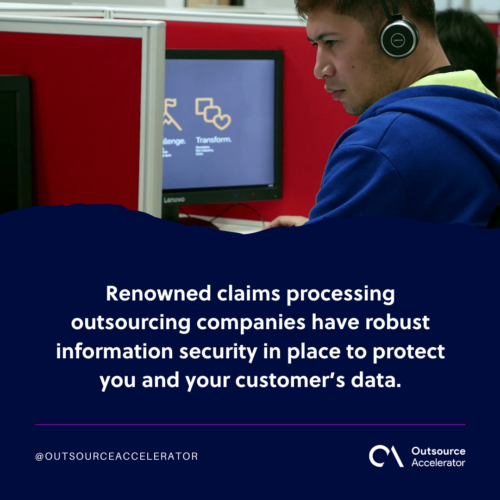
Top CPO firms keep strong security in place. So they protect both you and your customers’ data. Good data security in outsourcing is not optional here.
Connext is a reliable BPO partner. It runs regular data processing checks, contract compliance reviews, and state-specific rule reviews. Ideally, your partner should do the same. As a result, you lower risk on every claim.
Industry expertise
Another key factor is your partner’s skill in claims processing. A firm with deep healthcare claims experience is the safer choice. In contrast, a new BPO with no track record carries more risk. Look for proven work in medical claims administration before you sign.
Claims processing outsourcing in the Philippines
Outsourcing claims processing is a win for both sides. It also helps you as an employer. In fact, it gives you access to more skilled and experienced workers. Many firms treat it as part of their wider insurance outsourcing plan.
Filipino workers are known for hard work and a positive attitude. They also have a strong grasp of English. So they can talk to your customers with ease.
Their traits also fit the job well. For example, they tend to be patient, friendly, and polite. In addition, the Philippines has a large pool of skilled staff. Many firms there offer claims processing. So you have plenty of options to choose from.
Are you keen to hire a Filipino claims team? Then start by shopping around and comparing prices. After that, you can make a final choice.
Do you want a full guide to claims processing outsourcing and the wider industry? Then visit outsourceaccelerator.com. The site lists thousands of BPO firms in its directory. It also hosts thousands of helpful articles about everything outsourcing.
Frequently asked questions
What is claims processing outsourcing?
It is the practice of handing insurance claim checks and verification to a third-party provider. The provider reviews each claim, confirms its merit, and helps process it on time.
How does claims processing outsourcing cut costs?
You skip the cost of hiring and training an in-house claims team. In addition, the provider brings its own tools and office space. So you avoid extra overhead.
Is my customer data safe with a CPO partner?
It is, as long as you pick a firm with strong security. Look for regular data checks, compliance reviews, and clear risk controls in the SLA.
Why do companies outsource claims to the Philippines?
The country has a large, skilled talent pool. Filipino staff also speak strong English and cost less than local hires. As a result, firms get quality work at a fair price.
What should an SLA for claims processing include?
It should list duties, service quality, and provider availability. It should also set clear timelines and security rules. So both sides know what to expect.
Key takeaways
- Claims processing outsourcing moves claim checks to a skilled third-party team.
- It cuts costs, speeds up claims, and improves the customer experience.
- Strong SLAs, proven tools, and solid data security lower your risk.
- The Philippines offers a large, skilled, English-speaking talent pool.
- The right partner turns a slow task into a fast, accurate, and reliable one.






 Independent





