
How an outsourced medical call center supports a healthcare facility


What is an outsourced medical call center?
An outsourced medical call center is a third-party team that handles non-clinical tasks for healthcare providers, such as scheduling, insurance checks, and patient calls.
This support frees up staff to focus on care. Here is what a medical call center delivers:
- Lower costs, without a drop in service quality.
- Faster appointment setting and insurance work.
- More time for doctors and nurses to spend with patients.
Outsourcing has become a popular strategy in healthcare. So it helps medical specialists manage the steady rise in the cost of care.
A medical call center supports facilities in many ways. In turn, healthcare workers can focus more on their patients.
Medical call centers offer an array of services, which we cover below. In addition, we look at the main uses and benefits of a medical call center. This support is a core part of wider healthcare BPO services.
Outsourcing medical call center
The healthcare sector is fast-paced and competitive. So medical establishments often run very busy day-to-day operations.
Today, providers face a clear challenge. They must stretch their resources while still giving great patient care. Outsourcing a medical call center is one solid fix. As a result, facilities protect their finances and use resources well.
Demand for medical call center outsourcing has grown fast. For example, many practitioners turned to it to gain efficiency and flexibility. In turn, they keep delivering quality service to patients.
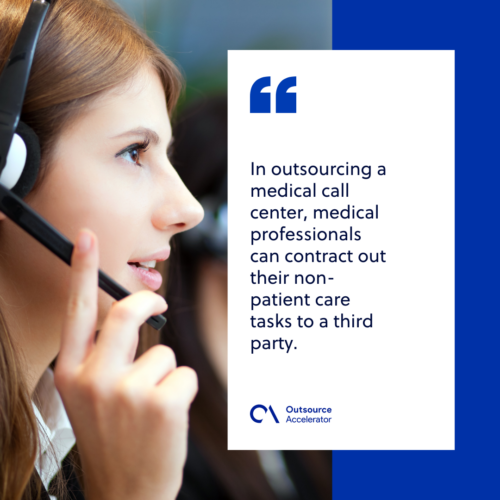
When they outsource, providers contract out their non-patient tasks to a third party. In addition, they can farm out services to local or offshore firms.
Medical call center services
As noted above, a medical call center covers a wide range of tasks. So outsourcing companies often provide the following.
Insurance verification
Outsourcing firms often offer a one-stop service that supports a patient’s insurance needs. For a deeper look, see this guide to insurance verifications. These services may include:
- Patient portfolio verification
- Eligibility verification
- Pre-authorization verification
Appointment setting
Appointment setting helps providers manage patient visits well. So by outsourcing appointment setting, facilities can cut down on patient no-shows. In addition, they keep better track of patient inflow.
Healthcare claims management
Contracting out this task lets facilities automate their claims systems. As a result, they lower the risk of claim denials or short pay from wrong records.
Physician referral services
Outsourcing firms often keep a detailed database of specialists and doctors. So through referral services, patients can reach a preferred facility or doctor. In turn, they get the information they need about services.
Revenue cycle management
Medical call center vendors can also help with billing and overall revenue cycle management. This ties closely to accurate medical billing.
Agents from premier providers like OP360 track the money patients owe for care. In addition, they send reminders and notices to insurers or patients about pending dues.
How a medical call center helps support the healthcare industry
A medical call center supports healthcare facilities in several key areas. Here is how.
Health insurance assurance
Every day, a big share of patient talks cover their healthcare insurance plans. As a result, these chats eat up a lot of a provider’s time.
Outsourcing firms have skilled, dedicated teams for insurance claims. In addition, their agents stay current on policy changes and protocols.
Achieve a stress-free appointment setting
Outsourced appointment setting helps providers streamline scheduling. In turn, in-house staff can focus on other key tasks.
Through a medical call center, doctors also get accurate details about patient appointments. So the whole process runs more smoothly.
Track and monitor patient satisfaction
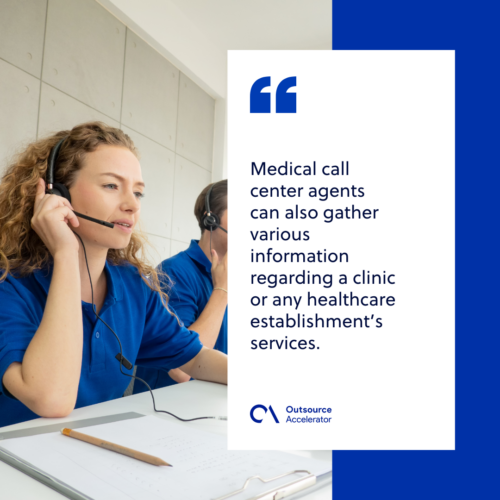
Medical call center agents can gather feedback about a clinic’s services. For example, they learn which areas need work.
They collect this data on patient satisfaction. As a result, the findings guide better decisions and stronger patient care management.
HIPAA compliance
A good medical call center must meet the Health Insurance Portability and Accountability (HIPAA) standards. As a result, patient data stays secure and private.
Keeping patient data both safe and easy to access is hard these days. So providers must pick a partner with strong security protocols.
Healthcare contact center providers like SixEleven hold their agents to the same HIPAA standards. In turn, medical teams get trained, Philippines-based staff for sensitive patient work, without losing data security or service quality.
Offers nurse triage services
A medical call center can also offer nurse triage. So patients get help to assess concerns without a trip to the emergency room.
A triage nurse checks how severe the symptoms are. Then the nurse advises the right next step.
This gives patients timely, fitting medical advice. In addition, it helps the facility run more smoothly and support strong care.
Improved patient care
Many outsourced tasks are routine and time-consuming. So by outsourcing, providers can spend more time and focus on patients.
They can also see more patients each day. As a result, they are freed from dull daily chores.
Want to learn more about farming out work in the medical field? Read more here.
Frequently asked questions about medical call centers
What services does a medical call center provide?
A medical call center handles insurance checks, appointment setting, claims, and referrals. In addition, many offer nurse triage and revenue cycle support.
Is a medical call center HIPAA compliant?
A reputable one is. It follows HIPAA rules and uses strong security to protect patient data. So always confirm a partner’s protocols before you sign.
How does a medical call center save money?
It shifts routine, non-clinical work to a third party. As a result, providers cut labor and overhead costs while keeping quality high.
Can a medical call center improve patient care?
Yes. By taking over routine tasks, it frees staff to focus on patients. In turn, wait times drop and service gets better.
Key takeaways
- A medical call center handles non-clinical tasks for healthcare providers.
- Core services include insurance checks, appointment setting, and claims.
- Strong HIPAA compliance keeps patient data safe and private.
- Outsourcing cuts costs and frees staff to focus on patient care.






 Independent





