
A brief walkthrough of the revenue cycle management


What is revenue cycle management in healthcare?
Revenue cycle management (RCM) is the financial process healthcare providers use to track patient care from registration through final payment.
- It links the clinical and business sides of a healthcare facility.
- It manages billing, coding, and insurance claims in one flow.
- Good RCM keeps a provider paid on time and financially healthy.
The outsourcing industry serves many types of sectors. Any outsourcing service helps these fields boost efficiency and support their growth.
Outsourcing is not just for firms in business. In addition, sectors like government, healthcare, and aviation can use what its services offer.
Take the healthcare industry. Because it is fast-paced and busy, outsourcing can lift worker output by a lot. This is true especially for healthcare revenue cycle management. As a result, it eases the heavy workload on staff, so they gain more room for other key tasks.
Revenue cycle management: The backbone of the healthcare industry
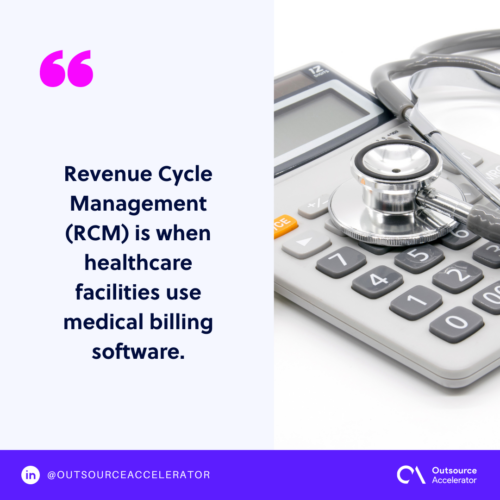
Revenue cycle management (RCM) is when healthcare facilities use medical billing software. So, this process lets them track patient activity, from registration and appointments to payments.
An RCM links the business and clinical parts of the healthcare sector through its data. Its main role is to talk with a patient’s insurance company.
When insured patients get treatment or supplies, providers sort them under the International Classification of Diseases (ICD-10) codes. Next, the facility sends the health summary plus the ICD and current procedural terminology (CPT) codes to the insurer.
From there, the insurer decides which services the plan covers. After that, patients pay the balance once the billing steps are done.
Key elements of the revenue cycle management
Providers have little control over the claim review and denial process. So, two elements drive the revenue cycle.
External factors
In some cases, claims and bills that take long to process end in rejection. For example, this may stem from insurance eligibility issues, fraud, health rules, or other reimbursement schemes.
Internal factors
Internal factors cover the provider’s costs for set procedures, services, or treatments. In addition, these revenue elements include staff skills and front and back-office workflow.
Revenue cycle management process
An efficient healthcare revenue cycle management process follows this typical workflow.
Patient scheduling/pre-certification
The cycle starts when a patient enters a facility and goes through pre-authorization. During this stage, staff collect insurance and demographic details from the patient.
Eligibility and verification of insurance
Eligibility checks happen before any service or procedure. A checklist tool sits inside the RCM software, so staff gather and inspect all required details. Patients also learn about the Explanations Of Benefits (EOB) statement. It spells out what their insurer will cover on their behalf.
Charge and code
A set of codes goes on record each time a patient visits. Professional medical coders handle this task. Also, all codes must follow the CPT guidelines and the updated ICD-10 system.
Deductibles and copayments
A deductible is a fixed amount a patient pays before the insurer starts to pay. Meanwhile, patients pay the copay at the facility after each appointment.
Submission of claims
At this stage, staff file all claims to the insurer through a clearinghouse. If the records are wrong, it leads to lower payments or more denials. RCM acts as the facility’s management software, so it links internal steps with billing software. After that, the billing company follows up with the insurer for claims.
Payment posting/reimbursement
Payment posting is when the insurer pays up. Because the bills are accurate, the reimbursement runs smoothly. However, denials happen when claims have missing or wrong information.
Manage denials
Staff resubmit rejected claims once they fix the coding errors. Then, each resubmitted claim gets a strict check under the latest coding rules. If payers cut back on reimbursement, the plan will not cover all costs. So, billers send outstanding balances to patients and follow up until they pay.

Importance of revenue cycle management
Good healthcare revenue cycle management helps providers stay financially healthy. However, internal and external factors both shape a provider’s revenue and survival.
As a business, healthcare organizations should keep improving their RCM. As a result, it supports their transformational growth. Above all, it helps them give full care to people in need.
Partner with Connext to simplify your revenue cycle and boost financial performance. Contact Connext today to access expert healthcare financial services and transform your RCM operations.
Frequently asked questions about revenue cycle management
What is revenue cycle management?
It is the process providers use to track patient care and payment. So, it runs from registration all the way to the final bill.
Why is revenue cycle management important?
It keeps a provider paid on time and cash flow steady. As a result, the facility stays financially healthy and can focus on care.
What are the main steps in the RCM process?
The key steps are scheduling, eligibility checks, coding, claim submission, and payment posting. Finally, staff manage any denied claims.
How does outsourcing help revenue cycle management?
Outsourcing takes billing and coding work off busy staff. Because of this, providers save time and reduce claim errors.
What causes claim denials?
Denials often come from missing details, coding errors, or eligibility issues. So, careful checks early in the cycle help prevent them.
Key takeaways
- Revenue cycle management tracks patient care from registration to payment.
- It links the clinical and business sides through shared data.
- Internal and external factors both shape a provider’s revenue.
- Clean coding and early eligibility checks cut down on denials.
- Outsourcing RCM frees staff and helps keep finances healthy.






 Independent





